
This guide explains how to find English-speaking doctors in Dubai and across the UAE in 2026, how to check their licence and how to pay.
What changed in 2025 and 2026
The biggest recent change is that compulsory employer-funded health insurance now covers the whole country. From 1 January 2025, private-sector employers and sponsors of domestic workers in Sharjah, Ajman, Umm Al Quwain, Ras Al Khaimah and Fujairah must provide at least a basic health insurance plan, as Dubai and Abu Dhabi already required. If you read older guides saying that insurance is “only compulsory in Dubai and Abu Dhabi”, that has been out of date since the start of 2025. Valid cover is also needed before a residence visa is issued or renewed; see our guide to the UAE residence visa.
Why it matters for finding a doctor: the basic plan in the northern emirates runs on a defined provider network, which MOHRE lists as 7 hospitals, 47 clinics and medical centres and 44 pharmacies, and a doctor’s referral is required for some care. Care outside that network is generally not covered unless it is an emergency. In practice, the list of doctors you can see “for free at the point of use” is set by your insurer, not by your own preferences.
| Item | Northern emirates basic plan (from 1 January 2025) |
|---|---|
| Who must be covered | Private-sector employees and domestic workers |
| Who pays the premium | The employer or sponsor |
| Annual premium | AED 320 basic, on a two-year policy; a reported AED 120 top-up (AED 440 in total) raises the cover |
| Outpatient (GP and specialist) co-payment | 25%, up to AED 100 per visit |
| Inpatient co-payment | 20%, up to AED 500 per visit and AED 1,000 a year |
| Medicines | 30% co-payment, covered up to AED 1,500 |
| Main exclusions | Pregnancy and childbirth and dental care (per MOHRE); press reports also list mental health (except emergencies), vision and hearing aids and cosmetic care |
Existing workers: According to MOHRE, employees whose work permits are dated before 1 January 2025 do not need the new cover until their residence permit is renewed. Some press reports gave 1 January 2024 as the cut-off; MOHRE’s own page is the authority. Ask your employer to confirm your renewal date.
A second, smaller change: during 2025 the Emirates Drug Establishment took over medicine registration and related regulatory functions from the Ministry of Health and Prevention (MOHAP), with the transfer reported as complete in December 2025. This does not change how you see a doctor, but if you need to check whether a medicine you take at home is registered in the UAE, the Emirates Drug Establishment is now the body to ask.
Who licenses doctors in each emirate
Every doctor in the UAE must hold a licence from the health regulator of the emirate where they practise, and the regulator differs by emirate. A doctor licensed only in Abu Dhabi cannot legally treat you at a Dubai clinic, so it is worth knowing which register to search. For the wider relocation process, see our complete expat guide to moving to the UAE.
| Emirate | Regulator | Public search tool | Notes |
|---|---|---|---|
| Dubai | Dubai Health Authority (DHA) | Dubai Medical Registry on the Sheryan portal | Filters include language, speciality, area, gender and facility |
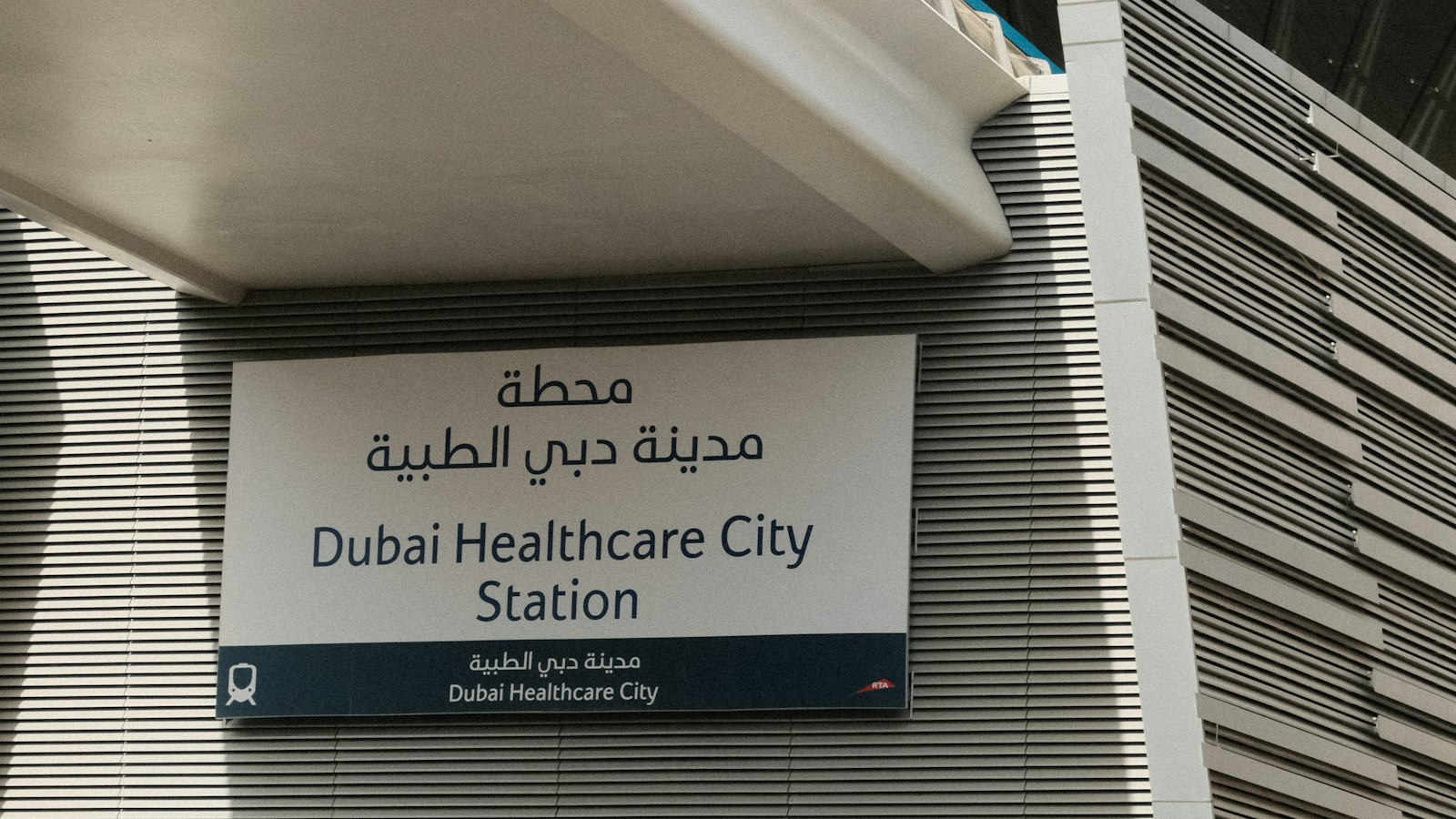
| Dubai Healthcare City (free zone) | Dubai Healthcare City Authority (DHCA) | DHCR register | A separate regulator for clinics inside the free zone |
| Abu Dhabi (including Al Ain) | Department of Health (DoH), formerly HAAD | “Find a Medical Professional” and “Find a Healthcare Facility” on TAMM | SEHA runs the public hospitals; DoH regulates them |
| Sharjah, Ajman, Umm Al Quwain, Ras Al Khaimah, Fujairah | Ministry of Health and Prevention (MOHAP) | Licence check on mohap.gov.ae | Emirates Health Services runs the federal public hospitals; MOHAP regulates |
Step by step: how to find an English-speaking doctor
Start with your insurance network, then narrow by language and location, then verify the licence. Doing it in that order avoids the most common and most expensive mistake: booking a doctor you like and then discovering your policy will not pay.
- Get your insurer’s provider list. Download the insurer’s app or network list and note your plan tier, because many insurers run several networks and the cheaper tiers exclude premium hospitals.
- Search the official register by language. In Dubai, the Dubai Medical Registry has a Language filter, so you can list licensed general practitioners or specialists who speak English (or your own first language) in your area. In Abu Dhabi and the northern emirates, search the regulator’s tool by name or facility, then check the clinic’s own website for languages spoken.
- Cross-check with the clinic. Call or message the clinic and ask which doctors consult in English, whether they accept your plan by name and tier, and whether direct billing applies.
- Confirm the licence. Before your first appointment, look the doctor up on the correct register (see the next section).
- Register with a regular GP. The UAE does not assign you a family doctor, so choosing one clinic for routine care, prescriptions and referrals keeps your records in one place.
Tip for non-English speakers in the family: If a relative is more comfortable in another language, look for a doctor who shares it. The Dubai registry’s language filter is the quickest official way to check, rather than relying on a clinic’s marketing page.
How to check that a doctor is licensed
Look the doctor up on the regulator’s register for that emirate; it takes under two minutes and costs nothing. This matters because only licensed professionals at licensed facilities can legally treat you, and insurers will not pay unlicensed providers.
| Check | Dubai | Abu Dhabi | Northern emirates |
|---|---|---|---|
| Professional licence | Dubai Medical Registry (search by name; shows licence type and category) | TAMM “Find a Medical Professional” | MOHAP licence check |
| Facility licence | Registry “Facilities” search, or the licence displayed at reception | TAMM “Find a Healthcare Facility” or search by facility licence number | MOHAP |
| Validate a sick note | Through the issuing facility | TAMM “Sick Leave Validation” | Through the issuing facility |
| Complaints | DHA medical complaints portal (mc.dha.gov.ae) | Contact DoH | Contact MOHAP |
In Dubai you can also ask to see the professional’s DHA licence card, and every health facility, including those in free zones, must display its licence.
Warning: Unlicensed practice does occur, particularly in the aesthetic and wellness sector. If a practitioner offers injections, drips or procedures, check both the individual and the facility on the register before you book, whatever language they speak.
Compare clinics that accept your insurance
See listed private clinics and medical centres in the UAE, then confirm direct billing with your insurer before you book.
Private clinic, government hospital or telemedicine?
For most expatriates, a private clinic inside the insurance network is the fastest route to an English-speaking doctor. Government hospitals also provide care in English, but expatriates usually access them through insurance or by paying, and waiting times for non-urgent appointments can be longer.
| Option | English availability | Typical access | Best for | Drawbacks |
|---|---|---|---|---|
| Private clinic or medical centre | Standard | Book directly, often same day or next day | GP visits, prescriptions, referrals, children’s care | Self-pay prices are high if outside your network |
| Private hospital | Standard | Direct or by referral | Specialists, scans, surgery, maternity | Premium hospitals often excluded from basic plans |
| Government hospital (SEHA, DHA, EHS) | Widely available | Through insurance or self-pay; emergencies for all | Emergencies, complex care | Longer waits for routine appointments |
| Telemedicine (insurer or clinic app) | Standard | Video or phone consultation | Minor illness, repeat prescriptions, advice | Not suitable for examinations or emergencies |
Insurance networks: the step most newcomers skip
Your plan, not the doctor’s language, decides where you can be seen without a large bill. Basic plans, including the Northern Emirates scheme described above, typically limit you to a named network and may require a GP referral before a specialist. Enhanced or international plans widen the network and may reimburse care outside it.
Questions to ask your employer or insurer before you need a doctor:
- Which network tier am I on, and which hospitals does it exclude?
- Do I need a GP referral before seeing a specialist?
- What is my co-payment per consultation, and is there an annual cap?
- Are maternity, dental and mental health covered? (Basic plans usually exclude them.)
- Are my spouse and children covered, or must I insure them separately?
If you want an English-speaking specialist outside your network, such as a particular obstetrician or psychiatrist, check whether your plan reimburses out-of-network care before booking. Our Health Insurance for Expats in the UAE guide covers plan types in detail.
Need better cover than the basic plan?
Compare insurance providers serving expatriates in the UAE, including plans with wider networks and maternity or mental health cover.
What a GP or specialist visit costs without insurance
Without insurance, a GP or specialist consultation in Dubai typically costs several hundred dirhams, with specialists usually charging more than GPs. There is no official national fee schedule for self-pay patients, so prices vary from clinic to clinic. For wider household costs, see our guide to the cost of living in the UAE.
Ask first: Prices vary widely by clinic, area and speciality. Always ask the clinic for its consultation fee before you attend, and confirm whether tests are charged separately. Abu Dhabi and northern emirates prices may differ.
Emergencies and urgent care
In a medical emergency anywhere in the UAE, call 998 for an ambulance. Go to the nearest hospital emergency department for serious problems; if you attend a private hospital outside your network, expect it to bill you or your insurer afterwards.
| Number | Service |
|---|---|
| 998 | Ambulance |
| 999 | Police |
| 997 | Fire (Civil Defence) |
For urgent but non-life-threatening problems in the evening or at weekends, many private medical centres open late, and most insurers provide a telemedicine service that can advise you where to go. Finding a GP is one of the tasks on our moving to the UAE checklist.
Save a local doctor before you need one
Find an English-speaking GP or family clinic close to your home or office now, so you are not searching during an emergency.
Frequently asked questions
