
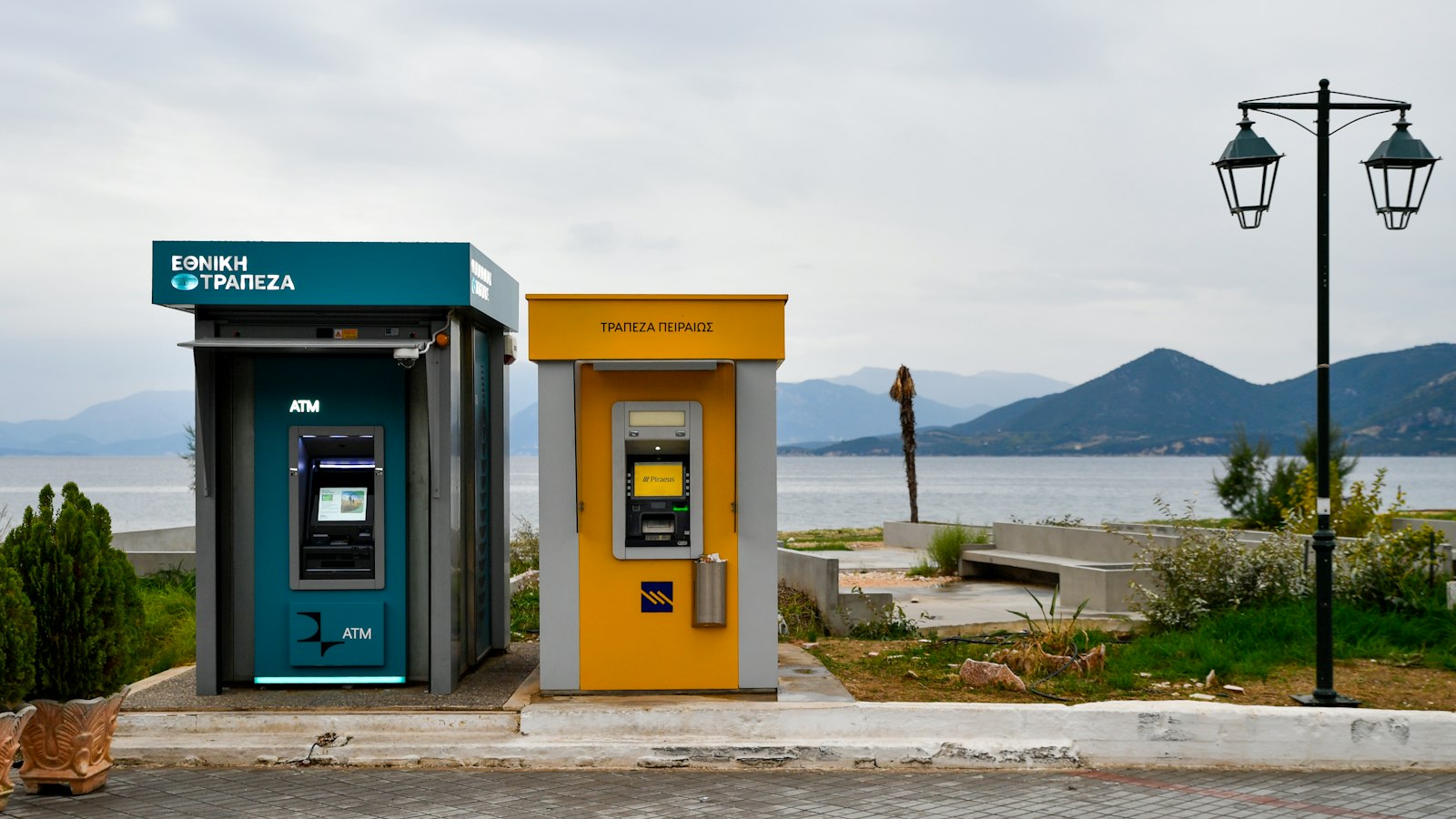
This guide explains how to open a bank account in Greece in 2026 as a resident or non-resident, with the documents and fees to expect.
What changed in 2025 and 2026
Four changes affect anyone opening a Greek account now: instant euro transfers became standard with a name check on every payment, Greek law made bank ATM withdrawals free, transfer fees were capped, and the AFM can be obtained online by video call.
| Change | Date in force | What it means for you |
|---|---|---|
| Instant euro transfers priced no higher than standard transfers (Regulation (EU) 2024/886) | 9 January 2025 | A Greek bank cannot charge more for an instant transfer than for an ordinary one |
| Every euro-area bank must send instant transfers | 9 October 2025 | Rent, deposits and salary payments can arrive within seconds, at any hour |
| Verification of Payee | 9 October 2025 | Your bank checks the name you type against the name held for the IBAN before you confirm a transfer |
| Law 5222/2025 on bank charges (Article 271) | Fee-free ATM rules from 11 August 2025 | No fee at a bank’s ATM with a card issued by a DIAS-member payment provider; independent ATM fees capped at €1.50; balance enquiries free |
| Transfer fee cap under the same law | 11 August 2025 | Digital transfers, including instant transfers between domestic banks, cost no more than €0.50 each for amounts up to €5,000 a day |
| IRIS mobile payment limits doubled, according to xpat.gr | 2026 | Bank tariffs cited show up to €1,000 a day between individuals and a separate €1,000 for payments to businesses, subject to each bank’s terms |
| AFM and authentication key issued together online, with identity checked by myAADElive video call | In use for the 2026 tax season | You can obtain the tax number most banks require without visiting a tax office |
| Announced for 2027: electronic money and payment institutions must offer instant euro transfers | 9 April 2027 | App-based providers that are not banks must catch up with the banks |
Give payers your name exactly as your bank holds it. Since October 2025, a landlord or employer who types your name differently from your account record will see a warning before paying you. Expats with double surnames, middle names or names transliterated from or into Greek are most affected. Check how your bank records your name in Latin characters and share that version.
Documents you need to open a Greek bank account
For most expats the essentials are an identity document, an AFM, proof of address and evidence of income; non-residents are also asked about their foreign tax residence and source of funds. Greek banks must identify every customer under anti-money laundering law, so expect a detailed questionnaire as well.
| Document | Residents of Greece | Non-residents |
|---|---|---|
| Passport or EU national identity card | Required | Required |
| AFM (Greek tax number) certificate | Normally required | Often required; some banks may not need it for certain non-resident routes |
| Proof of Greek address (registered lease, utility bill) | Usually requested | Foreign address evidence instead |
| Proof of income or employment (employer certificate, payslip, Greek tax return) | Usually requested | Recent foreign tax return often requested |
| Foreign tax identification number | If you remain tax resident elsewhere | Required |
| Source of funds evidence | Sometimes requested | Often requested |
| Residence permit (non-EU citizens) | Ask the bank whether it is required | Not applicable |
| AMKA (social security number) | Not normally needed for an ordinary account | Not needed |
Requirements differ between banks and between branches, so confirm the list before your appointment. Non-EU citizens on a residence permit route, such as the digital nomad permit, should ask whether the bank will accept the permit application receipt while the card is pending; the Greece digital nomad visa guide explains the permit timeline.
Tip: Let the bank pull your data from the state registers. Participating Greek banks use the government’s eGov-KYC service, which, with your consent, obtains verified identity, income, contact and professional data from public registers. You access it through the bank’s web banking using your TAXISnet credentials (the same codes issued with your AFM). It speeds up identification, although the bank still carries out its own checks.
Getting your AFM first
Get your AFM before you approach a bank, because most Greek banks, landlords and utility companies ask for it. It is the personal tax identification number issued by the Independent Authority for Public Revenue (AADE).
AADE’s guidance for non-residents says the application is made “exclusively electronically” through the “TIN & Authentication Key” application on the myAADE portal, and the same application issues the authentication key used to create your online tax codes.
| Step | What happens |
|---|---|
| 1. Start the application on myAADE | Complete the online “Obtain TIN and Authentication Key” form |
| 2. Prove your identity | Visit a tax office, or complete a video call through myAADElive (a booked appointment, or an instant call with the first available agent) |
| 3. Show your documents | Passport or national identity card; a valid, verifiable residence permit if you hold one; a translated marriage certificate where relevant |
| 4. Appoint a tax representative if required | AADE lists a power of attorney or solemn declaration appointing the representative and the representative’s own acceptance, both via gov.gr or a Citizens’ Service Centre |
| 5. Receive the certificate | If you apply yourself, the AFM certificate and authentication key are emailed to you |
According to To Vima’s February 2026 report, only people acting on their own behalf can use the video call route, an expired or unverifiable residence permit blocks the request, and people connecting from abroad should check spam folders and time-zone settings for the confirmation emails. AADE’s page does not list a fee.
Correcting an outdated assumption. Many English-language guides still say you must visit a Greek tax office in person, or pay an agent, to get an AFM. AADE now handles applications online through myAADE, and identity can be confirmed by video call from abroad. You may still choose to pay an accountant or lawyer, particularly if you need a tax representative, but it is no longer the only practical route.
Choosing a bank: branch, remote opening or payment app
Most expats open an account with one of Greece’s four large banks, National Bank of Greece, Piraeus Bank, Alpha Bank and Eurobank, and many keep an international payment app alongside it for currency transfers.
| Factor | Large Greek banks (branch) | Remote opening with a Greek bank | International payment apps |
|---|---|---|---|
| How you open it | Branch appointment | Online, with identity and residence conditions | Online |
| Who can use it | Residents and, at some banks, non-residents | Eurobank’s international route requires you to live and work in a country in the EU’s PRADO document system, with an identity document from such a country; Alpha Bank advertises remote banking for selected countries | Depends on the provider |
| Greek IBAN and Greek card | Yes | Yes | Depends on the provider |
| Covered by the August 2025 ATM fee rules | Yes, with a Greek bank card | Yes, with a Greek bank card | Not if the card is issued by a foreign institution |
| Best for | Salary, rent, mortgage, tax payments | Getting started before or soon after arrival | Receiving foreign income and changing currency |
A Greek bank account makes it easier to pay rent, utilities and Greek taxes and to receive a Greek salary. If you plan to buy property in Greece, a relationship with a Greek bank also helps if you later need a mortgage. You can compare banking providers in Greece that work with international customers.
Greek bank fees in 2026: what the law now caps
Greek law now bans or caps the fees that used to make everyday banking expensive: Greek bank ATM withdrawals and balance enquiries are free, independent ATMs may charge no more than €1.50, and digital transfers cost no more than €0.50. Monthly account fees still apply at many banks; the standard packages in the examples below cost less than €1 a month.
What the law says
Article 48 of Law 5167/2024, as replaced by Article 271 of Law 5222/2025, applies to payment service providers established in Greece and to ATM operators, for individuals, sole traders and freelancers.
| Charge | Rule |
|---|---|
| Cash withdrawal at a bank’s ATM with a card issued by a DIAS-member payment provider | No fee |
| Cash withdrawal in a municipal community that has only one ATM | No fee, whoever operates it |
| Cash withdrawal at an independent ATM with no ownership link to your card issuer | Maximum €1.50 |
| Balance, account and transaction enquiries at ATMs | No fee |
| Web, mobile and standing order payments to the state, social security funds, local authorities, utilities, telecoms and insurers | No fee |
| Standard and instant transfers between domestic banks through digital channels, up to €5,000 a day | Maximum €0.50 per transfer, incoming or outgoing |
| Prepaid card top-ups and withdrawals up to €100 a day via digital channels | No fee |
Warning: Foreign cards are outside the fee caps. PowerGame’s August 2025 explainer notes that the rules do not cover cards issued by foreign banks, and that Viva cards are also excluded. If you withdraw cash in Greece on a UK card, your own bank’s charges apply, and independent ATMs may also offer “dynamic currency conversion” at a poor exchange rate. Decline the conversion and pay in euros.
Monthly account fees: examples
The examples below come from a 2026 comparison by xpat.gr (updated 19 August 2026), which notes that they are not a complete price comparison. Fees change, and most banks waive the monthly charge if conditions are met, so check each bank’s current fee schedule before you apply.
| Account | Monthly fee | Notes |
|---|---|---|
| Eurobank My Blue Advantage | €0.60 | Exemptions available on conditions |
| Alpha Bank Benefit Base | €0.80 | Check current conditions |
| National Bank of Greece Benefits Account | €0.80 | Check current conditions |
Banking costs are small next to rent and energy; for a full monthly budget see the cost of living in Greece for expats.
Step-by-step: opening your account
With your AFM and identity document ready, a resident can often open an account at a single branch appointment, and some banks allow remote opening.
- Obtain your AFM. Apply through myAADE as described above. If you are a non-EU citizen, apply for your residence permit as well; the residency guide sets out the routes.
- Choose the bank and account. Compare monthly fees, the conditions for waiving them, and whether the app and contract are available in English.
- Gather your documents. Passport or identity card, AFM certificate, proof of address such as a registered lease, and proof of income.
- Complete identification. In branch, the bank copies your documents; online, follow the bank’s remote identification steps. If the bank offers eGov-KYC, use your TAXISnet codes to share data from the state registers.
- Answer the anti-money laundering questionnaire. Expect questions about your occupation, expected income, source of funds and the purpose of the account. Answer consistently; mismatches are a common cause of delay.
- Declare your tax residence. Under international reporting rules you state where you are tax resident and give your tax number for each country.
- Receive your IBAN and card. Give your IBAN to your employer and landlord and set up payments for utilities; the guide to renting in Greece explains how rent is normally paid.
- Set up the app and IRIS. Activate mobile banking and, if you want instant payments to a mobile number, register for IRIS.
No reliable universal timescale exists: digital approval can be quick for eligible applicants, while non-resident, foreign tax or source-of-funds reviews take longer.
Never let anyone else use your account. Banks screen for accounts used to receive and pass on money for other people. Forwarding payments for someone else, even a friend or a supposed employer, can lead to the account being closed and to criminal investigation.
The basic payment account: your right to a bank account
Every consumer legally resident in the EU has the right to open a basic payment account with a Greek bank, and the bank must open it or refuse it without undue delay and within 10 working days of a complete application. The right comes from Articles 16 to 18 of Law 4465/2017.
| Rule | What Law 4465/2017 says |
|---|---|
| Which banks must offer it | Every credit institution providing payment services to consumers, except institutions that offer accounts only online |
| Who is entitled | Consumers legally resident in the EU, wherever they live; also people without a fixed address, asylum seekers, and people without a residence permit whose removal is impossible for legal or practical reasons |
| Deadline | Open or refuse without undue delay and no later than 10 working days after a complete application |
| Mandatory refusal | Where opening the account would breach anti-money laundering law |
| Optional refusal | Where you already hold a basic payment account at a Greek bank, unless you declare that you have been warned it is closing |
| Written reasons | Free of charge, with information on how to complain and on the alternative dispute resolution body, except where security or anti-money laundering rules prevent it |
| Tie-in sales | Access cannot depend on buying other services or bank shares, unless that applies to all customers |
| Cost | Free or for a “reasonable” fee, set with regard to national income levels and average Greek bank charges |
Unlike some EU countries, Greek law does not set a specific income threshold below which the basic account is automatically free. It allows ministers to require more favourable terms for vulnerable consumers. Ask the bank for its basic account fee schedule in writing.
If you are refused, follow up with the bank in writing and ask for the specific reasons. You can then use the complaint route set out in the refusal letter, including the competent authority and the alternative dispute resolution body it names.
Non-residents and keeping a UK or foreign account
You can open a Greek account without living in Greece, but expect extra checks on your foreign tax residence, income and source of funds, and fewer accounts to choose from. Non-resident accounts are common among people buying a holiday home or paying Greek bills from abroad.
| Option | Who it suits | Main drawback |
|---|---|---|
| Greek non-resident account | Second-home owners, people paying Greek bills from abroad | More due diligence; some banks accept a power of attorney, others do not |
| Greek resident account | Anyone living in Greece | Needs a Greek address and, usually, an AFM |
| Account in another euro-area country | The first weeks after arrival | Card withdrawals in Greece fall outside the Greek fee caps |
| UK or other non-euro account with a currency service | Receiving pension or income from home | Exchange costs; must be declared once you are Greek tax resident |
Where sources conflict. Most English-language guides say an AFM is always required to open a Greek account. xpat.gr’s August 2026 guide says it is commonly required for residents and for accounts linked to Greek employment, property or tax, but may not be needed for some non-resident routes. In practice, ask the specific bank before you apply, and assume you will need an AFM if you plan to rent, buy or work in Greece.
If you are moving from the UK, keep your UK account open while you settle, but check your UK bank’s policy on customers living abroad; the moving to Greece from the UK checklist includes this step. Once you are Greek resident, GOV.UK says you must submit an annual declaration of assets that includes “any assets held outside Greece”, and it warns of severe penalties for failing to do so. Foreign accounts also need to be reflected correctly in your Greek tax return; see taxes for expats living in Greece.
If you are setting up a company or working as a freelancer, you will need a separate business account; the guide to starting a business in Greece as a foreigner covers the extra documents.
Declare your foreign accounts correctly in Greece
Compare English-speaking tax advisers who handle expat returns and asset declarations in the ExpatListing directory
For help choosing, read the guide to expat tax advisers in Greece or browse tax advisers in Greece.
How safe is your money? Deposit protection in Greece
Deposits at Greek banks are protected up to €100,000 per depositor, per bank, by the Hellenic Deposit and Investment Guarantee Fund (TEKE), with up to €300,000 of extra temporary cover for certain one-off sums such as the proceeds of a home sale.
| Feature | Protection under Law 4370/2016 |
|---|---|
| Standard limit | €100,000 per depositor, per credit institution, across all accounts and currencies |
| Temporary high balances | Up to €300,000 more, for up to six months from the date each amount is credited |
| Qualifying events | Sale or expropriation of a private home or plot, court-ordered payments between spouses, retirement lump sums or pension payments, severance, compensation for injury or wrongful detention, insurance benefits, inheritance |
| Timing condition | Funds credited within one month of the event, or documented in writing as coming from it |
| Claims | Filed with TEKE within three months of the date the bank becomes unable to repay |
The temporary cover matters if you sell a home in the UK and hold the proceeds in Greece before buying, or if you receive a retirement lump sum. If you bank with a brand that is not a Greek credit institution, ask which deposit guarantee scheme covers your money.
The complete guide to moving to Greece sets out where banking fits in your first weeks, and the Greece country hub lists every provider category.
Frequently asked questions
