
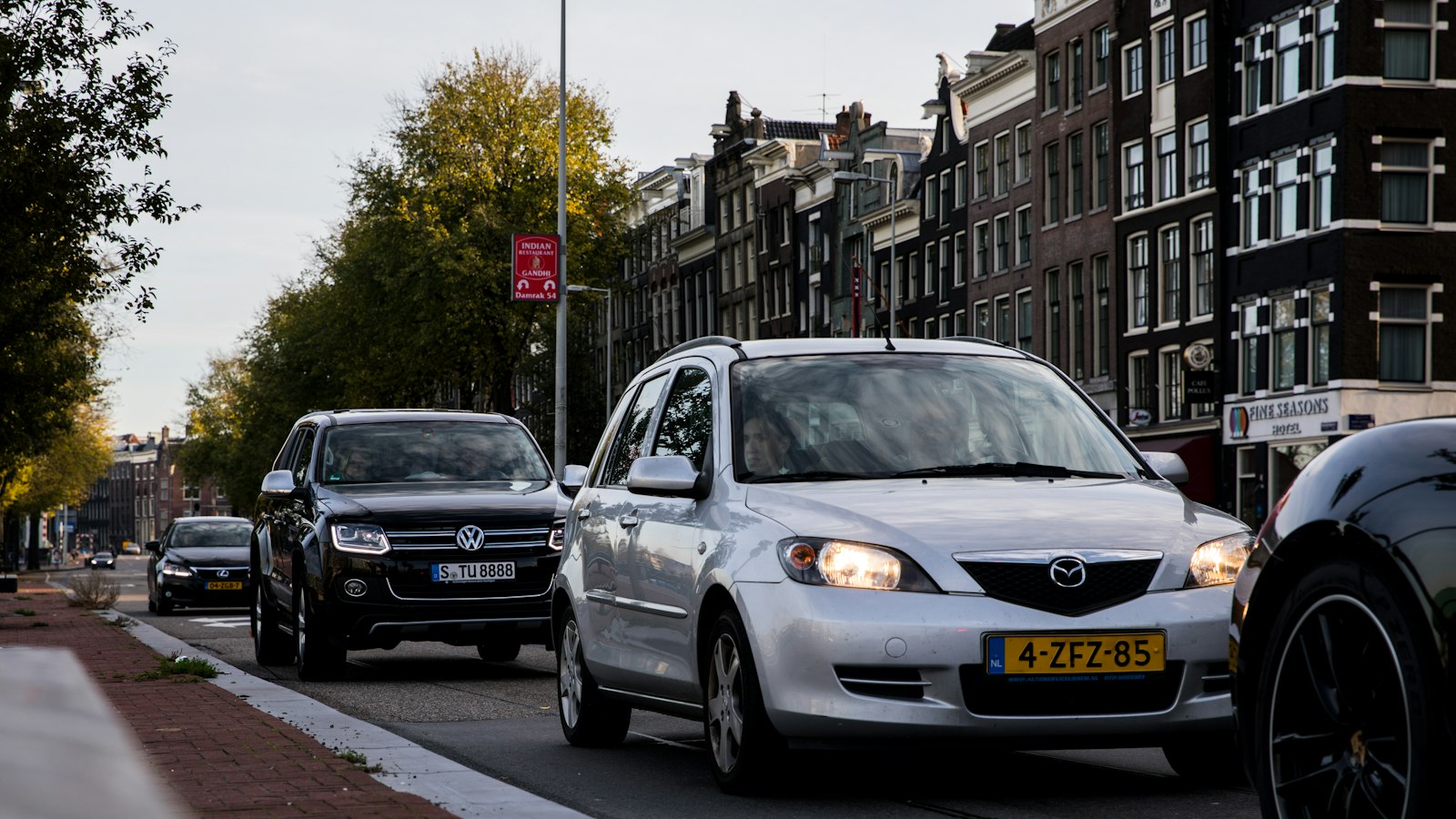
This guide covers driving in the Netherlands as a visitor or resident in 2026: which licence you can use, when to exchange it and the rules of the road.
What changed in 2025 and 2026
The biggest recent changes for foreign drivers are a much smaller road tax discount for electric cars from 2026, a lower but rising company car benefit-in-kind rate for electric cars, and the first zero-emission zones for vans and lorries since 1 January 2025. None of these changes the core licence rules, but each affects the cost of driving here.
| Change | Effective date | What it means for you |
|---|---|---|
| Motor vehicle tax (MRB) discount for fully electric cars cut from 75% to 30% | 1 January 2026 (30% applies 2026–2028) | Electric car owners now pay 70% of the normal rate; the discount is due to fall to 25% in 2029 and end in 2030 |
| Company car benefit-in-kind (bijtelling) for electric cars set at 18% | 2026 (20% in 2027, 22% in 2028) | Applies to the first €30,000 of list price; matters if your employer provides an electric car |
| Municipalities allowed to introduce zero-emission zones for vans and lorries | 1 January 2025 | Does not affect private passenger cars, but does affect anyone running a van for work |
Outdated advice warning: If you read elsewhere that electric cars are almost exempt from Dutch road tax, that was true in 2025 (a 75% discount). Since 1 January 2026 the discount is 30%, so check current figures before budgeting for an electric car.
How long can you drive on a foreign licence?
It depends entirely on where your licence was issued and when, according to the RDW (the Dutch vehicle and licensing authority). The clock for non-EU licences starts when you take up residence, which in practice means registering in the Personal Records Database (BRP) at your municipality. Registration is one of the first steps covered in our complete guide to moving to the Netherlands.
| Licence issued in | How long it remains valid after you move | What you must do next |
|---|---|---|
| EU/EFTA (cars and motorcycles: AM, A1, A2, A, B, BE), issued before your move | Until 15 years after its issue date, as long as it has not expired | Exchange for a Dutch licence before that 15-year point |
| EU/EFTA, already more than 15 years old when you move | Two years from the date you moved | Exchange within those two years |
| EU/EFTA lorry and bus categories (C1, C, D1, D and trailers) | Up to five years from the issue date | Exchange before that point |
| EU/EFTA, issued after you registered in the Netherlands | Not valid for driving here at all | Exchange it through your municipality |
| Outside the EU/EFTA (including the UK, US, Canada, India, Australia) | 185 days from your move | Exchange it (if eligible) or pass the Dutch tests |
| Any licence held by a tourist (not resident) | For the length of your visit, if valid | Carry an International Driving Permit if your licence does not use A, B, C, D or E categories |
The RDW gives a practical example: someone living in the Netherlands since 15 June 2024 with an EU licence issued on 1 January 2019 can drive cars and motorcycles on it until 1 January 2034, while the lorry and bus categories on that licence remain usable only until 15 June 2026.
Do not get caught out: Once your permitted period ends, you may not drive on the foreign licence, even if your exchange application is still being processed. The RDW advises applying early because processing takes at least 15 working days.
For UK drivers specifically: since Brexit, a UK licence is treated as non-EU, so the 185-day limit applies. The good news is that UK licences (Great Britain and Northern Ireland, plus Gibraltar, Guernsey, Jersey and the Isle of Man) are on the RDW list of exchangeable licences for all categories. Our dedicated guide to exchanging a UK driving licence in the Netherlands covers this in detail.
Can you exchange your licence, or must you resit the test?
EU/EFTA licences can always be exchanged, even if expired; non-EU licences can be exchanged only if the issuing country has an agreement with the Netherlands, or if you qualify for the expat scheme (the 30% ruling). Everyone else must pass the CBR theory and practical driving tests.
| Your situation | Exchange possible? | Categories you receive | Health declaration needed? |
|---|---|---|---|
| EU/EFTA licence (valid or expired) | Yes | Same as your licence | Sometimes |
| UK, Gibraltar, Guernsey, Jersey, Isle of Man, Monaco | Yes | All categories (for Great Britain, BE only if you passed a separate test for it) | Yes |
| Japan | Yes, with conditions | A and B | Yes |
| Singapore | Yes | A and B | Yes |
| Israel, Taiwan, Andorra, South Korea, Alberta, Québec | Yes | B (car) only | Yes |
| Any other country, and you hold the 30% ruling | Yes | Per your licence | Yes |
| Any other country (e.g. most US states, India, Australia), no 30% ruling | No | Must pass CBR theory and practical tests | Yes, for the test route too |
| Previously held a Dutch licence valid after 30 June 1985 | Yes | Same categories as the old Dutch licence | Depends |
The country list above reflects the RDW page at the time of writing and can change, so check the RDW before you rely on it.
Three conditions apply to most non-EU exchanges:
- You must have lived in the issuing country for at least 185 days in the year you obtained the licence.
- You need a valid residence permit (or fall under specific EU arrangements such as Association Decision 1/80 or temporary protection). You cannot exchange while waiting for a new permit to be issued.
- The licence must still be valid. An expired non-EU licence cannot be exchanged, so start before it runs out.
30% ruling holders: If you came as a highly skilled migrant and the tax authority has granted you the expat scheme, you can exchange a licence from any country. You will need the tax authority’s decision letter (the RDW calls it the “Decision on the Evidence Rule”) with your application. This is one of the most valuable and least understood benefits of the scheme for drivers from the US, India and similar countries. See our guide to working in the Netherlands as an expat for how the ruling works.
How the licence exchange works, step by step
You apply at your own municipality (gemeente), not at the RDW directly; the RDW then decides within about 15 working days.
- Check eligibility using the table above and gather your documents.
- Obtain a health declaration (Gezondheidsverklaring) from the CBR if your licence is from outside the EU/EFTA. Allow time: the CBR assessment can take a while, although the RDW says this document may be submitted after the application.
- Book an appointment at your municipality, complete the application form and pay the fee. The fee varies by municipality, so check your own gemeente’s website.
- The municipality forwards your application to the RDW. Only the municipality can submit it.
- The RDW writes to you within 15 working days. If approved, you can collect your Dutch licence from the municipality from 5 working days later. Missing information delays this.
What to bring:
- A colour passport photograph meeting Dutch requirements
- Your foreign driving licence (you will not get it back)
- A certified translation if the licence is in non-Latin script, such as Japanese or Greek
- The 30% ruling decision from the tax authority, if you work here with a non-EU licence and rely on the expat scheme
- The CBR health declaration, where required
- Your old Dutch licence, if you have one
Travel warning: You must hand in your foreign licence when you apply. You may keep driving in the Netherlands if your permitted period has not ended, but the RDW advises against driving abroad during processing, and there is a small risk of a fine if you are stopped. Plan international trips around the exchange.
If you need a certified translation of your licence, browse sworn translators in our directory or read our guide to certified translation services in the Netherlands.
Dutch road rules that catch foreigners out
The rules that most often surprise newcomers are the daytime 100 km/h motorway limit, priority for traffic from the right, and the sheer volume of cyclists.
| Road / vehicle | Limit |
|---|---|
| Motorway, 06:00–19:00 | Almost all 100 km/h (some stretches 80 km/h, a few 130 km/h) |
| Motorway, 19:00–06:00 | Often 100, 120 or 130 km/h, as signed |
| Car towing a trailer or caravan under 3,500 kg | 90 km/h |
| Car towing a trailer over 3,500 kg | 80 km/h |
| Lorries | 80 km/h |
Outside motorways, the usual default limits are 50 km/h in built-up areas, 80 km/h on rural roads and 100 km/h on expressways, but many towns and cities have lowered large parts of their road network to 30 km/h. Always follow the signs. On motorways, an electronic matrix sign showing a lower limit overrides the roadside sign.
Other rules to know:
- Alcohol: the limit is 0.5 per mille for experienced drivers and 0.2 per mille for novice drivers. The 0.5 limit also applies to cyclists.
- Phones: you may not hold a phone or other mobile device while driving or cycling.
- Priority from the right: at unmarked junctions, traffic from the right has priority, and this includes cyclists. Shark’s teeth markings (white triangles) on the road show where you must give way.
- Trams and buses: in towns they generally have right of way; give them space.
- Cyclists: when turning right, always check for cyclists coming up on your inside. Many bike paths run alongside the road and cross side streets.
- Warning triangle: not legally required to carry, but you must use one in certain situations, such as when your hazard lights fail. Carrying one, plus high-visibility vests, is sensible.
Traffic fines in 2026
The Netherlands enforces traffic offences mainly by camera, and fine amounts are updated each year on 1 January. Fines from cameras are sent to the registered keeper, including keepers of foreign-registered cars through cross-border enforcement.
Holding a phone while driving, running a red light and not wearing a seatbelt all carry fines of well over €100, and speeding fines rise steeply with each km/h over the limit, on top of a €9 administration charge. The Public Prosecution Service (OM) publishes the current amounts in its online Boetebase. More serious speeding is dealt with by the OM directly, which can mean higher penalties and, in some cases, losing your licence.
Low-emission and zero-emission zones
Two separate systems apply: low-emission zones (milieuzones) can bar older diesel cars, while zero-emission zones affect only vans and lorries, not private cars.
| Zone type | Who is affected | Current rule |
|---|---|---|
| Milieuzone (low-emission zone) | Passenger cars, vans, and in some cities scooters and motorcycles | Older diesel cars and vans are barred, with the minimum emission class set by each city; petrol, electric and hydrogen cars may enter |
| Zero-emission zone | Vans, box vans and lorries only | Allowed since 1 January 2025, and a growing number of municipalities are introducing one. Older diesel vans keep access only for a transitional period that depends on their emission class, so check the current dates for each city |
Cameras at zone entrances read number plates. Amsterdam, The Hague and Utrecht all operate low-emission zones; check the municipality’s website before driving an older diesel into a city centre, especially if it is on foreign plates.
Bringing your own car to the Netherlands
Once you are a resident, you may drive a foreign-registered car for only a short period before it must be registered with Dutch plates; the RDW does not state a fixed number of days on its English page. If your car is from another EU country, you may be able to import it without paying BPM (the Dutch purchase tax on cars). Our Netherlands country hub lists relocation, transport and insurance providers who work with expats.
BPM exemption for household goods (moving from another EU country):
- You must have owned and used the car for at least 6 months before the move.
- You must have lived normally in the other EU country for at least 12 months before the move.
- You must apply within 12 months after moving.
- If you sell, rent out or lend the car within 12 months of the exemption, BPM becomes payable.
If you are moving from outside the EU/EFTA, including from the UK, the process starts with Customs rather than the Belastingdienst, so check the Customs rules before shipping a car.
RDW registration fees for an imported light vehicle:
| Item | Fee |
|---|---|
| Identification (inspection) of the vehicle | €58.50 |
| Registration certificate | €50.00 |
| Registration in your name | €13.10 |
| Recycling fee | €22.50 |
You need to be registered in the BRP, book an RDW inspection, bring the original foreign registration certificate and the tax office’s confirmation that the car counts as household goods, and then have Dutch plates made by an authorised manufacturer.
Before you ship a car: Dutch prices for imported left-hand-drive cars, BPM liability for non-qualifying vehicles, and the cost of converting a right-hand-drive UK car can make selling and rebuying cheaper. Compare costs first; our guide to how much it costs to move to the Netherlands can help you budget.
Insurance, inspection and motor vehicle tax
Every Dutch-registered car must have at least third-party liability insurance (WA), pass a periodic roadworthiness test (APK), and pay motor vehicle tax (MRB).
| Obligation | What it is | Who enforces it |
|---|---|---|
| WA insurance | Compulsory third-party liability cover; extra cover (limited or comprehensive) is optional | CJIB fines for missing insurance |
| APK | Roadworthiness test, annually or every two years depending on the vehicle, at an RDW-approved garage | CJIB fines for a missing APK |
| MRB | Motor vehicle tax, billed automatically once the car is registered in your name | Belastingdienst |
| BPM | One-off purchase/registration tax on cars and motorcycles | Belastingdienst |
A note on electric cars in 2026: the MRB discount for fully electric cars is 30% from 2026 to 2028 (down from 75% in 2025) and is scheduled to fall to 25% in 2029. If your employer provides an electric company car, the benefit-in-kind rate is 18% in 2026 on the first €30,000 of list price, rising to 20% in 2027 and 22% in 2028.
Frequently asked questions
